





R&D, Quality Control & Production Technology
Innovative Technology Transforms Professional Kitchens
Pursuing research and development that delivers unique value and a manufacturing system that maintains world-class quality, the Hoshizaki continues to give tangible form to the specific needs of professionals based on its founding philosophy. With advanced technology and a stable supply system working in tandem, it continues to develop products that foodservice professionals can rely on with complete confidence.

R&D and Quality Control System
Creating Original Products Based on Proprietary Technologies to Continually Meet Customer Needs
Since its founding, Hoshizaki has upheld the corporate philosophy that a company without original products cannot achieve growth, and has pursued the creation of original products based on proprietary technologies.
R&D Divisions of the Hoshizaki Group
Based on the strategic direction, these divisions are responsible for establishing core technologies, developing product functions using new fields and technologies, and conducting advanced product development focused on component and control technologies.
R&D Divisions at Each Plant
These divisions are primarily responsible for developing new products manufactured at their respective plants, as well as model changes and product improvements. They pursue product development aligned with strategy while also advancing technologies suited to regional characteristics.
R&D and QA Collaboration Ensures Product Quality
The Hoshizaki Group maintains an integrated research and development structure covering everything from market research and component technology development to prototyping, design, and production follow-up, enabling the Group to respond to a wide range of customer needs.
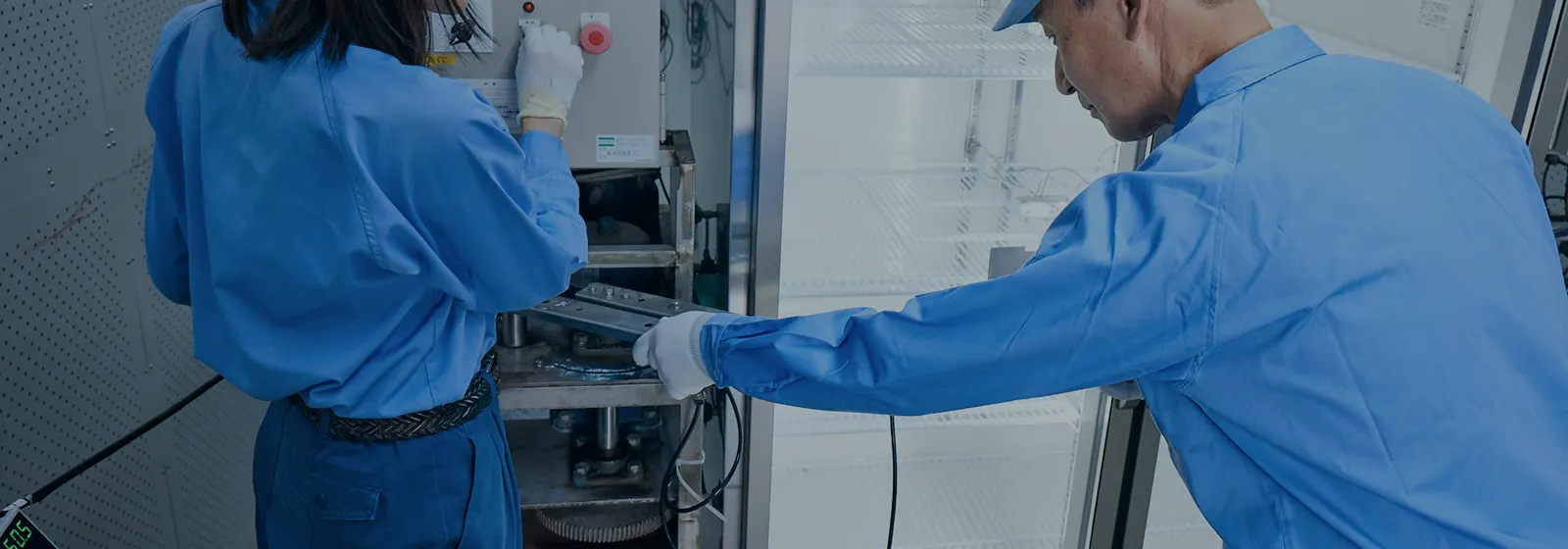
During the design and development stage, strict quality standards are established, and products are structurally designed to withstand the demanding environments of commercial use, ensuring high quality. In testing rooms designed to simulate high-temperature, high-humidity kitchen environments, repeated testing is conducted under severe conditions, and only technologies and components that pass these tests are adopted. This is the reason Hoshizaki products experience fewer breakdowns compared with competitors’ products.

R&D Concepts Aligned With Modern Needs: Environment, Safety, Hygiene, and Energy Efficiency
In recent years, Hoshizaki has focused on addressing global issues related to the environment, safety, hygiene, and energy conservation. The X Type energy-saving commercial refrigerator developed in FY2005 adopted the industry’s first inverter control system and received the Chairman's Award at the 16th Energy Conservation Grand Prize, hosted by the Energy Conservation Center, Japan. Its successor, the Z Type, further advanced energy-saving performance and achieved a 49% reduction in energy consumption. The M Series fully automatic ice maker redesigned its ice-making structure to significantly improve cost-effectiveness while maintaining ice production capacity, achieving:
* Approximately 50% reduction in water consumption
* Up to 30% reduction in electricity consumption through the adoption of high-efficiency compressors and motors
Hoshizaki developed and commercialized undercounter dishwasher models that have achieved:
* Approximately 43% reduction in rinse water consumption
* Approximately 71% reduction in detergent usage, reducing environmental impact
Across other product categories as well, Hoshizaki continues to develop products that significantly reduce running costs while promoting energy conservation and resource savings.

※ Annual power consumption figures are based on the measurement and calculation methods specified in JIS B 8630 (2009 edition).
Measurement conditions: Ambient temperature: 30°C; Ambient humidity: 70% or higher; Internal temperature (Refrigeration compartment: 4°C or below, Freezer compartment: −20°C or below); Door openings (Refrigeration compartment: once every 5 minutes, held open for 10 seconds, 72 times/day; Freezer compartment: once every 15 minutes, held open for 10 seconds, 24 times/day); Annual power consumption is calculated as daily power consumption × 365 days
Quality Control System Designed to Respond Quickly and Reliably to Any Nonconformity
In Japan, Hoshizaki collects and analyzes all nonconformity data, regardless of whether it originates from its own plants or from suppliers and subcontractors, with the goal of preventing recurrence.
For suppliers where nonconformities recur, factory audits and corrective guidance are conducted. If quality improvements are not observed, measures such as restricting new parts orders, reducing existing business transactions, or terminating business relationships may be implemented.
This strict quality control system supports the delivery of products that achieve high levels of customer satisfaction.

Manufacturing Technology System
Stable Supply Backed by Advanced Manufacturing and Quality Assurance
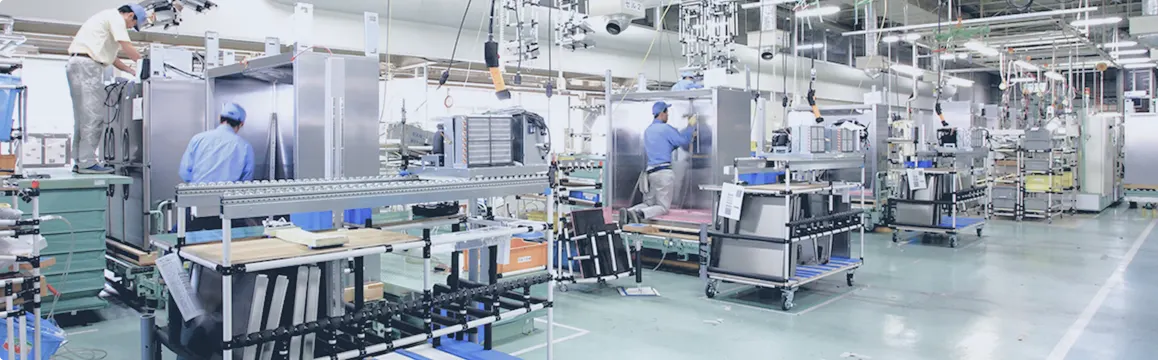
Manufacturing operations in Japan are primarily handled by Hoshizaki Corporation. Embedded within this manufacturing technology system are the unique strengths of the Hoshizaki Group that play a vital role in ensuring a stable supply of the products our customers require.
Strengths of the Hoshizaki Group’s Manufacturing Technology

Environmentally Conscious Manufacturing and Future Direction
Since May 2006, the Group has been working to transition manufacturing equipment in order to achieve lower global warming potential. Beginning in January 2007, production started on table-type refrigerators using a cyclopentane foam insulation process that does not use fluorocarbons. Plans are currently underway to transition and introduce this technology at factories in Japan.
At the same time, growing environmental considerations required of companies in recent years have also become one of the factors driving up product costs. In addition, rising raw material prices associated with increases in crude oil prices have made cost reduction initiatives an urgent priority. In response, the Group continues to pursue cost reduction activities through production improvements and overseas procurement of raw materials.
These initiatives are also being advanced overseas.